Puzzle Time - Daily Puzzles!
- 4.2
- Rating
- 50.00K
- Installs
- Free
- Price
 Analysis by App-foxy
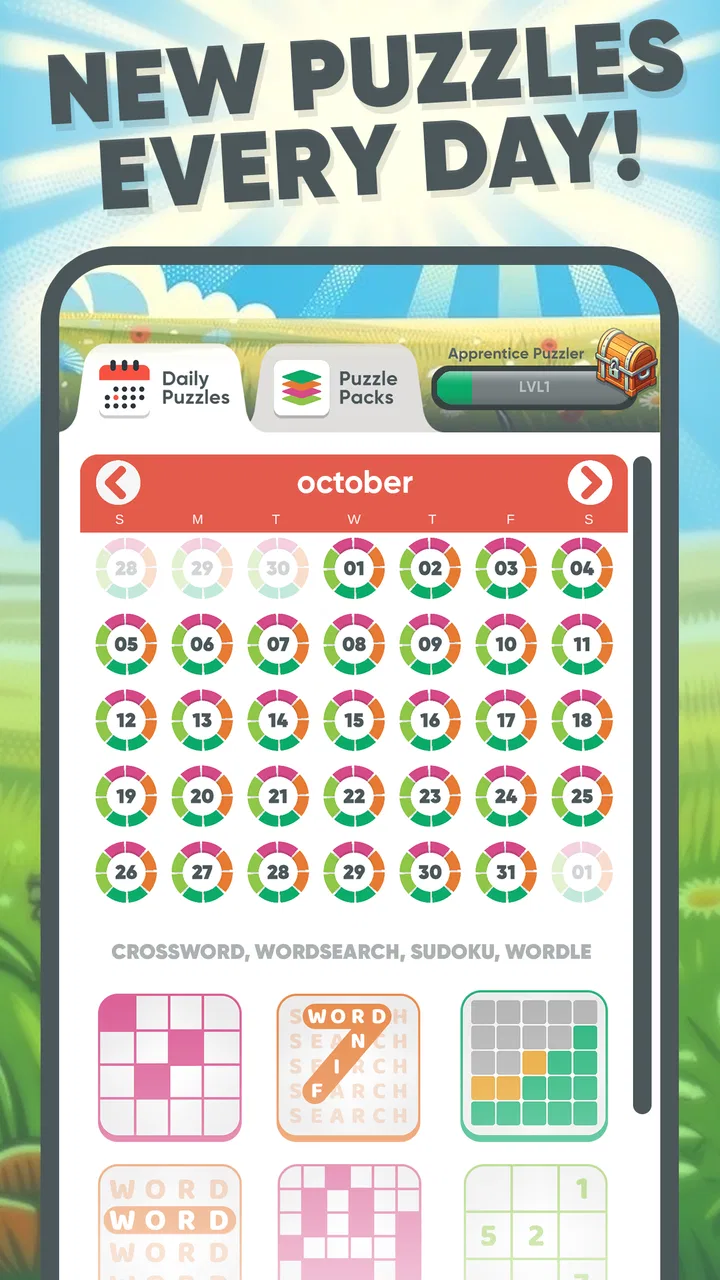
I spent time with Puzzle Time - Daily Puzzles! as a compact word-game collection rather than treating it as one single puzzle format. That distinction matters: the app brings together crossword solving, wordsearch, Wordle-style play, Sudoku, and other daily challenges, so its appeal comes from variety and routine. I found it easiest to enjoy in short sessions, when I wanted something mentally active without committing to a long game.
It is a free game in the word category from Karma Games | Word Puzzles & Games to play daily. The app has an average rating of 4.2 from around 700 ratings and has passed 50 thousand installs, which gives it a modest but meaningful player base. Its Everyone age rating also makes the tone approachable for families, casual players, and anyone who prefers clean puzzle entertainment over competitive action.
How Puzzle Time feels in everyday use
I find this collection easiest to enjoy when I pick a puzzle to match the moment rather than trying to work through everything in one sitting. A useful habit is to decide whether I want word recall, clue-solving, visual scanning, or number logic before I open a game; that small choice makes a brief break feel more intentional. From there, the appeal is in how each format shapes the pace of a session.
You May Also Like

 Blood Strike: 2.5 Anniversary
Blood Strike’s Loadouts Turn Every Drop Into a Tactical Gamble
A close look at Blood Strike’s custom loadouts: how fast access to signature weapons reshapes its battle royale rhythm, rewards preparation, and narrows the gap between fights.

 Pandora - Music & Podcasts
Pandora’s Music Is Easy to Start, but Harder to Recover
Pandora’s strength is its low-effort path from a seed to a station. Its weak spot is how much confidence it asks you to place in connection, setup, and quiet recovery.

 8 Ball Pool
 Is Built on Rivalries, Rematches, and Routine
A close look at the rivalries, rematches, shared routines, and unanswered safety questions that turn a quick pool match into a persistent mobile community.

 Samsung Music
’s Quiet Strength Is Playing What You Already Own
Its reach comes less from spectacle than from dependable access to a personal library. That simplicity is both the app’s strongest retention engine and its ceiling.

 AccuWeather: Weather Radar
AccuWeather Review: A Quick, Clear Forecast for Everyday Decisions
For everyday plans, the best forecast is the one you can understand quickly. AccuWeather makes rain timing, radar, and local conditions easy to act on, with a few trade-offs.

 Hill Climb Racing
Why Hill Climb Racing Still Turns Crashes Into One More Run
A tiny car, a bumpy hill and one more upgrade: Hill Climb Racing keeps resurfacing because its simple chaos makes every near-miss feel personal.
More From Our News Desk
View All News


Quick starts and reasonable speed expectations
The most convincing part of the experience is how naturally it fits into spare minutes. I can imagine opening it while waiting for an appointment, taking a short break from work, or settling down with a coffee. Crossword clues and word searches encourage a slower, thoughtful pace, while a Wordle-style challenge gives the session a clearer beginning and end. Sudoku adds another kind of concentration, so I do not feel forced to play the same mental game every time.
Because the app is built around familiar puzzle types, I did not need a long tutorial before starting. That helps the first launch feel approachable, especially for someone who already knows how a crossword, word search, or Sudoku grid works. The trade-off is that experienced puzzle fans may find the individual formats less distinctive than specialist apps devoted to only one of them.
In my experience, the speed expectation should be modest and practical rather than demanding. This is not the kind of game I would choose for rapid reactions or a visually intense challenge. Its value is in getting me into a puzzle quickly and letting me decide whether to stop after one round or continue with another format.
The current version is 8.4.2, and the app supports devices running Android 8.0 or later. Those details make it relevant to people using older phones, although actual responsiveness will still depend on the device, available storage, and what else is running in the background. I would not assume that an older supported phone will feel exactly like a recent model, but the minimum requirement is not unusually demanding for a puzzle game.
What happens during heavier puzzle sessions
The app becomes more interesting when I use several puzzle types in one sitting. A typical session might begin with a word search, move to a crossword when I want clues, and finish with Sudoku when I prefer numbers and deduction. That variety reduces boredom, but it also means the experience depends on how smoothly the app moves between its different sections. A collection like this is most useful when changing activities feels effortless rather than like starting a separate game each time.
For heavier use, I would treat it as a collection for repeated short sessions instead of a single marathon challenge. Crossword solving can stretch longer if I get stuck, while a daily word challenge may be over quickly. Sudoku can occupy more attention depending on the grid and my own solving style. The result is flexible, but not perfectly predictable: some visits will last only a few minutes, and others can easily expand when one clue keeps me interested.
One practical tip is to switch formats when concentration drops instead of abandoning the app entirely. If word clues start feeling repetitive, Sudoku changes the type of thinking required. If numbers feel tiring, a word search offers a more visual task. This is a genuine strength of the collection, because the app can remain useful even when my preferred puzzle mood changes.
There is also a downside to that flexibility. Players who want a deep progression system around one format may feel that their attention is scattered. A dedicated crossword app can offer a more focused identity, and a dedicated Sudoku game may provide a more specialized solving environment. Puzzle Time is better suited to people who value choice over depth in one particular discipline.
Reliability and recovering an interrupted session
For a daily puzzle app, reliability is not only about launching successfully. It is also about whether the game remains comfortable when I pause, switch to another app, or return later. Short puzzle sessions naturally create interruptions, so I would judge this title by how well it supports that stop-and-start habit rather than by expecting a long uninterrupted play period.
My preferred workflow is simple: open the app, choose the puzzle that matches my energy, solve for a while, and leave without feeling that I have wasted time. That makes it a good companion for fragmented schedules. A parent waiting during an activity, a commuter with a few spare minutes, or someone taking a screen break can use it in a way that a longer story-driven game cannot easily match.
Recovery is also important when a puzzle becomes difficult. I do not want one obscure clue to make the entire session feel blocked. The collection helps indirectly by giving me another activity to try, but that is not the same as solving the original obstacle. My advice is to treat the formats as a rotation: leave a stubborn crossword clue, try Sudoku or a word search, and return later with a fresher approach.
That workflow reveals a subtle limitation. Variety can rescue a dull moment, but it can also make the app feel less focused if I am looking for a strong sense of long-term achievement. People who enjoy recording personal solving times, building a detailed streak, or mastering one specialized ruleset may prefer an alternative designed around that single goal.
Resource demands and older-device considerations
Puzzle Time is fundamentally a low-intensity type of game. Crossword grids, letters, clues, word searches, and Sudoku do not suggest the kind of visual workload associated with three-dimensional games or fast multiplayer titles. I would therefore expect it to be a more sensible choice for modest hardware than an action game, particularly when the main priority is quiet, readable puzzle play.
That does not mean every older phone will feel identical. Screen size can affect comfort, especially when a grid contains many small cells or when I need to scan a dense word search. A larger display may make extended sessions easier on the eyes, while a smaller phone is more convenient for quick use. If you are choosing between devices, I would prioritize readable text and responsive touch input over raw gaming power.
The Android requirement of 8.0 or later keeps the app accessible to a broad range of devices. Still, anyone using an older supported phone should keep expectations realistic about switching speed and general smoothness. Background apps, limited free space, and an aging battery can affect any game, even one with simple puzzle presentation. I would close unnecessary apps before a long session if the phone already feels sluggish.
Another consideration is the free-to-play structure. The game costs nothing to install, but in-app purchases range from $1.49 to $49.99 per item. That does not automatically make the experience unsuitable, but it means I would pay attention to the purchase flow and decide in advance whether I want to spend anything. For a casual puzzle collection, setting a personal limit is sensible, particularly if several short sessions turn into a daily habit.
Where it fits among other word and puzzle games
Compared with a traditional newspaper crossword, this app is more convenient because several puzzle styles are gathered in one place. I do not need to carry a separate puzzle book or decide in advance whether I want words or numbers. The trade-off is that a physical newspaper can feel more deliberate and focused, while a multi-format mobile collection may encourage quick switching.
Compared with a specialist Wordle-style game, Puzzle Time offers broader variety but may be less satisfying for someone who wants one carefully defined daily ritual. Compared with a dedicated Sudoku app, it gives me more ways to spend a few minutes but may not be the best choice for someone who wants Sudoku to be the central experience. Its strongest comparison point is convenience: one installation covers several familiar habits.
I also see it as a better fit than a general brain-training app for players who want recognizable puzzles rather than a broad program of exercises. Crossword clues and word searches feel like leisure activities first. Sudoku adds structured logic, but the overall tone remains casual. If you want a competitive leaderboard, a narrative campaign, or an elaborate skill system, this is probably not where I would start.
The developer’s identity, Karma Games | Word Puzzles & Games to play daily, matches that daily-collection approach. The app is clearly positioned for repeat visits, but I would not confuse “daily” with a requirement to play every day. I get more from it when I use it as an optional mental break instead of turning it into another obligation.
Three useful ways to get more from the collection
First, I would choose the puzzle type based on the kind of attention I have available. Wordsearch works well when I want a visual scan and a relatively direct objective. Crosswords are better when I am comfortable thinking through clues and tolerating uncertainty. Sudoku suits a quieter period when I want deduction rather than vocabulary. Making that choice deliberately prevents the app from feeling like a random pile of mini-games.
Second, I would use a difficult puzzle as a stopping point rather than a test of patience. If I keep returning to the same clue while tired, I am likely to enjoy the app less. Moving to another format preserves the session and may help me return with a better idea later. This is especially useful on a phone, where interruptions are common and puzzle time is rarely perfectly planned.
Third, I would consider screen comfort before judging the game’s overall quality. A small display can make dense grids feel cramped, and long sessions may be less pleasant than short ones. Increasing system text size, cleaning the screen, and holding the device at a comfortable distance can matter more here than performance specifications. Puzzle games reward clear reading and accurate tapping, so physical comfort directly affects enjoyment.
Who should choose it, and who should skip it
I would recommend Puzzle Time to someone who wants a free, approachable collection of everyday puzzles and does not want to install separate apps for crosswords, word searches, Wordle-style play, and Sudoku. It is particularly suitable for casual players, families looking for Everyone-rated entertainment, and people who prefer short sessions that can expand when they have more time.
It is also a reasonable option for owners of older Android phones, provided the device runs Android 8.0 or later and remains comfortable with grid-based reading. The game’s category and format make it less demanding in spirit than action-heavy alternatives, although I would still judge the experience on the particular phone rather than assuming identical performance everywhere.
I would skip it if my main goal were a highly specialized crossword experience, advanced Sudoku depth, competitive multiplayer, or a rich narrative. I would also be cautious if I dislike free games that include optional purchases, since the available items can reach $49.99. Even without spending, the presence of purchases may be a distraction for some players.
My performance verdict
After looking at the app as a daily-use game rather than just a list of puzzle names, I think its best quality is practical flexibility. It can fill a short wait, support a longer relaxed break, and change direction when one type of puzzle stops being enjoyable. That makes it more versatile than a single-format title, especially for players whose interests vary from day to day.
The limitations are equally clear. The collection approach may feel less deep than specialist alternatives, and the free structure requires awareness of optional spending. Older devices should be compatible from Android 8.0 onward, but comfort and responsiveness will still depend on the phone. I would not choose it for demanding graphics, intense competition, or a carefully structured long-term campaign.
Overall, I see Puzzle Time as a dependable casual choice for people who want several familiar mental games in one place. Its 4.2 average and more than 50 thousand installs suggest that it has found a real audience without needing to be treated as a major competitive title. I would install it for variety, use it in short daily breaks, and keep a specialist puzzle app nearby only if I wanted deeper focus in one format.
My final recommendation: try it if convenience and variety matter more to you than advanced progression. The free entry makes that decision easy, and the combination of word and number puzzles gives the app a useful role on a phone. Just approach it as a relaxed puzzle shelf, not as a replacement for every dedicated game in the category.
FAQs for Puzzle Time - Daily Puzzles!
01What is Puzzle Time - Daily Puzzles!?
Puzzle Time - Daily Puzzles! is a casual puzzle app designed for short, regular brain-training sessions. It provides daily challenges that can be played at your own pace, making it suitable for users who enjoy logic games, word challenges, number puzzles, or other bite-sized activities. The daily format encourages consistency without requiring long gaming sessions.
02How does the daily puzzle system work?
The app presents a new puzzle or challenge each day, giving you a simple reason to return regularly. Depending on the version and available puzzle modes, completed challenges may include a score, time, streak, or performance summary. Some daily content may be limited to one attempt or reset after a set period, so checking the in-app instructions is recommended before starting.
03Is Puzzle Time - Daily Puzzles! free to download and play?
Puzzle Time - Daily Puzzles! can generally be downloaded without an upfront purchase, but the exact free content may vary by platform and app version. Some features, additional puzzle packs, advertisements, or optional upgrades may require payment. Before downloading, review the store listing for current pricing, subscriptions, in-app purchases, and any limits placed on the free version.
04Can I play Puzzle Time - Daily Puzzles! offline?
Offline availability may depend on how the app delivers its daily content. Previously loaded puzzles can often remain accessible without an internet connection, but downloading a new daily challenge, synchronizing progress, viewing rankings, or restoring purchases may require online access. If offline play is important to you, open a few puzzles while connected and test the app before relying on it without mobile data.
05Who is Puzzle Time - Daily Puzzles! suitable for?
The app is a good choice for players who prefer relaxed, short-form entertainment rather than lengthy levels or competitive action. It can suit adults, older children, and puzzle fans looking to exercise observation, memory, vocabulary, logic, or problem-solving skills. However, difficulty and age suitability can vary by puzzle type, so parents should review the content and store rating before allowing younger users to play.
Pros
- Fresh daily puzzles make it easy to build a consistent solving habit.
- Short challenges fit well into commutes or quick breaks.
- Varied puzzle types help keep the experience from feeling repetitive.
- Simple controls make the game approachable for casual players.
- Daily progress gives players a reason to return regularly.
Cons
- Some puzzles may feel too easy for experienced puzzle fans.
- Missing a day can make the daily routine feel less satisfying.
- Hints or extra features may be limited without optional purchases.
- Puzzle variety may depend heavily on the current daily selection.
- Players seeking a story or deeper progression may find it basic.

Puzzle Time - Daily Puzzles!
Gallery